How Poor Onboarding Negatively Affects Your Company
Hiring someone is exciting. It usually means the business is growing, the workload is increasing, or the founder is finally ready to get support.
OPERATIONS & GROWTH
6/5/2026
Hiring someone is exciting. It usually means the business is growing, the workload is increasing, or the founder is finally ready to get support.
But hiring someone is not the same as onboarding them.
Many businesses still treat onboarding like a quick office tour, a few introductions, and a binder full of information that may or may not be current. The new employee or contractor is expected to sit with someone, watch what they do, ask questions, and somehow figure out the rest along the way.
That may have worked years ago when teams were smaller and businesses moved slower. But in today’s working environment, especially with hybrid teams, remote contractors, multiple software platforms, and faster client expectations, that kind of onboarding creates confusion before the person even has a chance to succeed.
A poor onboarding process does not just affect the new hire. It affects the owner, the team, the client experience, and the overall efficiency of the business.
Hiring Fills The Role. Onboarding Sets The Person Up To Succeed.
Recruiting is about finding the right person.
Onboarding is about giving that person the right information, tools, access, training, expectations, and support so they can perform the role properly.
When these two things are treated as the same process, the business usually ends up with gaps. The person may have the skills, but they do not know how your business operates. They may understand the job title, but they do not understand your internal process. They may be eager to help, but they are forced to ask for every detail because nothing is clearly documented.
That is where the real cost begins.
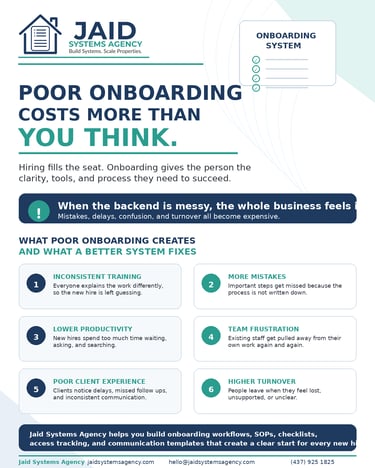
1. Inconsistent Training Creates Confusion
When there is no structured onboarding system, training depends on who is available that day.
One employee may explain the process one way. Another person may explain it differently. A manager may skip a few steps because they assume the new hire already knows them. Someone else may share an old version of a checklist or tell the person to do something the business no longer does.
Now the new person is not being trained into a system. They are being trained through memory, habits, and personal preference.
That creates confusion.
The new hire starts second guessing what they were told. They may not know which version of the process is correct. They may feel uncomfortable asking too many questions. They may try to piece things together on their own and accidentally create errors.
A proper onboarding system makes sure everyone receives the same information from the start. It removes the guesswork and creates a consistent experience for every new employee or contractor.
2. More Mistakes Happen When Processes Are Not Documented
Most mistakes do not happen because people do not care. They happen because people were not given the full process.
If important steps live in someone’s head, they are easy to miss.
For example, a new team member may not know:
Which folder to save documents in
Who needs to approve a task before it moves forward
What information must be collected from a client
Which email template should be used
What the deadline is for a certain step
How to escalate an issue
Which system holds the most current information
When those details are not documented, errors become predictable.
A missed step can lead to delays, duplicated work, compliance issues, unhappy clients, or extra work for the team. The founder may end up stepping back into the business to fix problems that could have been prevented with a clearer onboarding process.
3. Lower Productivity Costs The Business Time
A new hire should not spend the first few weeks trying to figure out where things are, who to ask, what tools to use, or how decisions are made.
When onboarding is weak, productivity slows down for everyone.
The new person spends time waiting for answers. The manager spends time repeating instructions. Other team members spend time explaining the same things over and over. Simple tasks take longer because the process is unclear.
That means the business is paying for time that is not being used efficiently.
A structured onboarding process helps the new person become useful faster. They know where to find information, what their responsibilities are, what systems to use, and what the first few days or weeks should look like.
Clarity creates momentum.
4. Frustrated Team Members Become Less Focused
Poor onboarding does not only affect the person being onboarded. It also affects the people around them.
When there is no clear system, existing team members become the default training department.
They are interrupted with questions. They stop their own work to explain tasks. They may give rushed answers because they are busy. They may become frustrated because they feel like they are constantly repeating themselves.
Over time, this creates tension inside the team.
The new person may feel like they are bothering everyone. Existing team members may feel like onboarding is slowing them down. The founder may feel like the new hire is not catching on quickly enough.
But the real issue is not always the person. Sometimes the system failed them.
A strong onboarding process protects the whole team. It gives the new person a clear place to start and gives the existing team a consistent structure to point them to.
5. Poor Onboarding Damages The Client Experience
Clients may never see your onboarding process, but they will feel the effects of it.
If a new employee or contractor does not understand your internal process, your client experience can become inconsistent.
That can show up as:
Delayed responses
Missed follow ups
Incorrect information
Incomplete files
Repeated questions
Poor handoffs
Different service quality depending on who handles the task
Clients do not usually care that someone is new. They care that the service they receive is smooth, professional, and reliable.
When the backend is messy, it often shows up on the front end.
A well built onboarding system helps protect the client experience by making sure new team members understand how your business communicates, delivers service, handles tasks, and follows up.
6. Higher Turnover Becomes More Likely
A new hire who feels lost, unsupported, or unsure of expectations may leave before they ever become fully productive.
This is especially true for contractors or remote team members. If they do not receive clear direction early, they may assume the business is disorganized. They may become frustrated. They may lose confidence. They may decide the role is not the right fit.
Turnover costs the business more than money. It costs time, energy, knowledge, client continuity, and team morale.
Then the founder has to start the hiring process all over again.
A strong onboarding process helps new employees and contractors feel welcomed, prepared, and clear about how to succeed. That matters.
What A Better Onboarding System Should Include
A proper onboarding system does not have to be complicated. It just needs to be clear, organized, and repeatable.
A strong onboarding process should include:
A welcome process
Role expectations
First day and first week checklist
Tool and software access list
Document and file location guide
SOPs for key tasks
Training resources
Communication expectations
Approval and escalation process
Client service standards
Progress check ins
A clear point of contact
The goal is simple. Every new person should start with the same information, the same expectations, and the same professional experience.
How Jaid Systems Agency Can Help
At Jaid Systems Agency, we help founders and business owners turn messy onboarding into a structured system.
As an Online Business Manager, Jaid Systems Agency can help you create the backend structure that makes onboarding easier for you, your team, and every new employee or contractor who joins your business.
We can help with:
Onboarding workflows
SOP creation and organization
Role based checklists
Training guides
Access and document tracking
New hire communication templates
Client handoff processes
Team accountability systems
Process mapping
Workflow setup inside your business tools
Instead of relying on memory, old binders, and whoever happens to be available to train that day, your business can have a process that is clear, consistent, and easy to follow.
Final Thoughts
Hiring the right person is only the first step.
If they walk into confusion, outdated information, unclear expectations, and scattered processes, the business is already making their success harder than it needs to be.
Better onboarding creates better results.
It helps your team work with clarity. It reduces mistakes. It protects the client experience. It saves time. It gives new employees and contractors a stronger start.
A good hire still needs a good system.
Jaid Systems Agency empowers business owners to scale with confidence through custom systems, streamlined operations, and strategic Online Business Manager support. We handle the behind-the-scenes complexity so you can focus on what you do best—growing your impact and revenue.
Phone
VIRTUALLY-ANYWHERE