The Efficiency Audit: Turning Busy Work Into High Income Activities
There comes a point in almost every small business where the owner looks up and realizes they are working all day, answering messages, solving problems, checking on staff, following up with clients, fixing mistakes, and putting out fires but somehow still not getting ahead.
OPERATIONS & GROWTH
Jaid Systems Agency
4/23/2026
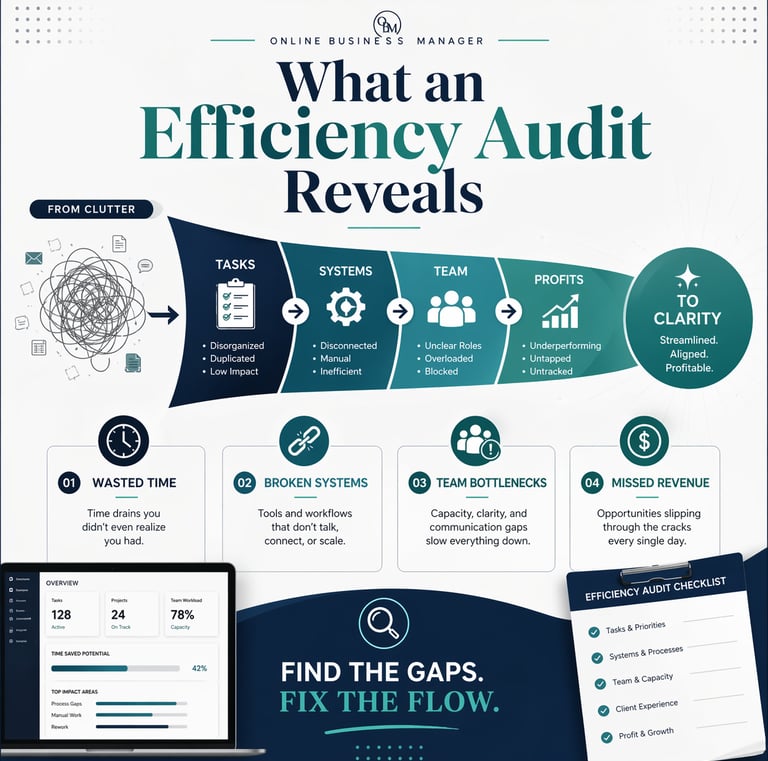
There comes a point in almost every small business where the owner looks up and realizes they are working all day, answering messages, solving problems, checking on staff, following up with clients, fixing mistakes, and putting out fires but somehow still not getting ahead.
The business is moving. Everyone looks busy. The phone is ringing. Tasks are getting done. But growth still feels heavier than it should.
That is usually the moment when a business does not need more hustle. It needs more clarity.
That is where an efficiency audit comes in.
An efficiency audit is a review of how work actually flows through your business. It helps you identify what is driving revenue, what is draining time, where communication is breaking down, where tasks are being repeated, and where better systems can create smoother day to day operations.
In simple terms, it helps you see the difference between productive work and busy work.
Busy work is the kind of work that fills your day but does not really move the business forward. It looks like searching for information in five different places, answering the same question over and over, manually following up with every lead, fixing things that were missed the first time, or relying on the owner to approve, explain, and remember everything.
Productive work is different. It is the work that creates sales, strengthens client relationships, improves service delivery, increases cash flow, and helps the business grow in a sustainable way.
A small business needs to know the difference because time is one of its most valuable resources. When a business owner or team spends too much of that time on repetitive, low value tasks, the business can start to feel stuck even when everyone is working hard.
What does an efficiency audit actually look at?
An efficiency audit looks at the moving parts of your business and asks practical questions.
How are tasks being assigned?
Where is client information stored?
How are leads being followed up with?
Who handles invoicing and what happens if they get busy?
Are procedures written down in a way the team can actually access?
Are people using multiple tools that do not connect?
Does everything depend on one person to keep moving?
It is not about judging how hard people are working. It is about understanding whether the business is set up in a way that supports growth or slows it down.
For many small businesses, the real problem is not a lack of effort. It is a lack of structure.
How does an efficiency audit help a small business?
It helps a small business stop operating in reaction mode.
When systems are unclear, the owner becomes the default answer for everything. Staff ask questions because they cannot find the process. Clients wait because follow ups are not consistent. Invoices go out late because no one owns that part of the workflow from beginning to end. Tasks sit in email, text messages, paper notes, spreadsheets, and someone’s memory.
Over time, this creates stress, delays, and lost opportunities.
An efficiency audit helps uncover those gaps so the business can improve how work gets done.
That might mean documenting procedures so staff can find answers faster. It might mean centralizing communication so nothing gets lost. It might mean automating routine reminders, lead follow ups, or internal task assignments. It might mean removing steps that are no longer necessary. It might also mean helping the owner step out of tasks that should be delegated.
The result is not just a neater business. It is a business that uses time better, makes fewer mistakes, responds more consistently, and creates more space for high value work.
Why should a small business have one?
Because small businesses do not always have the luxury of wasted time.
In a larger company, inefficiencies can hide behind departments, layers of staff, or bigger budgets. In a small business, they are felt immediately. They show up as delayed revenue, exhausted owners, inconsistent service, missed opportunities, and a constant feeling of being behind.
Many business owners assume that once they hire more people, things will improve. But hiring into chaos usually multiplies the chaos. If the workflow is unclear now, adding more people without fixing the process often creates even more confusion.
That is why an efficiency audit matters.
It gives you a chance to clean up the operational side of the business before growth stretches it further. It helps you build a stronger foundation so growth feels supported instead of stressful.
Signs your small business may need an efficiency audit
There are usually warning signs.
One of the biggest ones is feeling busy all day but still not making meaningful progress on the work that actually grows the business.
Another sign is when the same questions keep coming up from staff or contractors. That often means the process is not clear, not documented, or not easy to access.
You may also need an efficiency audit if tasks are spread across too many places. Maybe some things live in email, some in text messages, some in a notebook, some in a spreadsheet, and some only in your head. That kind of setup makes it easy for things to fall through the cracks.
Other signs include missed follow ups, delayed invoicing, repeated mistakes, duplicated work, inconsistent client communication, and feeling like nothing can move unless you personally touch it first.
If your business feels overly dependent on you, that is a major clue.
An example of why this matters
Let’s say there is a small service based business with five team members. The owner handles incoming leads, responds to client questions, checks on staff, sends invoices, reminds the team about procedures, and follows up on unfinished tasks.
The team is working hard. Everyone is busy. But the owner is exhausted and still feels like the business is always behind.
After taking a closer look, the real issues become clear.
Client communication is spread across email, phone, and text messages.
Team procedures exist, but they are in a binder that no one checks in the middle of a workday.
Invoices are sent manually, and there is no set rhythm for when they go out.
Lead follow ups depend on the owner remembering to send them.
Staff keep interrupting the owner because there is no central place to check what to do next.
This business does not have a motivation problem. It has a workflow problem.
An efficiency audit would identify each of those pressure points and help build a better process. The business could move procedures into a digital format that staff can access quickly. Lead follow ups could be templated or automated. Tasks could be tracked in one central system. Invoicing could follow a more consistent process. Team communication could be streamlined so fewer things get lost.
Now the owner spends less time reacting and more time focusing on sales, strategy, relationships, and growth.
That is the power of an efficiency audit. It turns operational chaos into something manageable.
Turning busy work into high income activities
One of the biggest benefits of an efficiency audit is that it helps business owners reclaim time for the work that actually matters.
High income activities are things like closing sales, nurturing leads, strengthening client relationships, building partnerships, improving service delivery, reviewing financial performance, and making better strategic decisions.
But those things often get pushed aside when the day is packed with administrative clutter.
The owner knows what they should be focusing on, but they are too buried in low value tasks to get there.
An efficiency audit helps create that shift.
It helps move the business away from constant firefighting and toward intentional operations. It gives the owner a clearer view of what should be delegated, automated, documented, streamlined, or removed altogether.
Final thoughts
A small business does not have to be large to need structure.
In fact, the earlier you review your efficiency, the easier it is to build a business that can grow without burning you out.
If your business feels busy but not smooth, productive but not scalable, active but not organized, an efficiency audit may be exactly what you need.
Because sometimes the next level is not more effort.
It is better systems, better flow, and a better use of your time.
And that is how you start turning busy work into high income activities.
Ready to stop building on shaky ground? Let's talk about what a solid foundation looks like for your business.
Jaid Systems Agency empowers business owners to scale with confidence through custom systems, streamlined operations, and strategic Online Business Manager support. We handle the behind-the-scenes complexity so you can focus on what you do best—growing your impact and revenue.
Phone
VIRTUALLY-ANYWHERE